
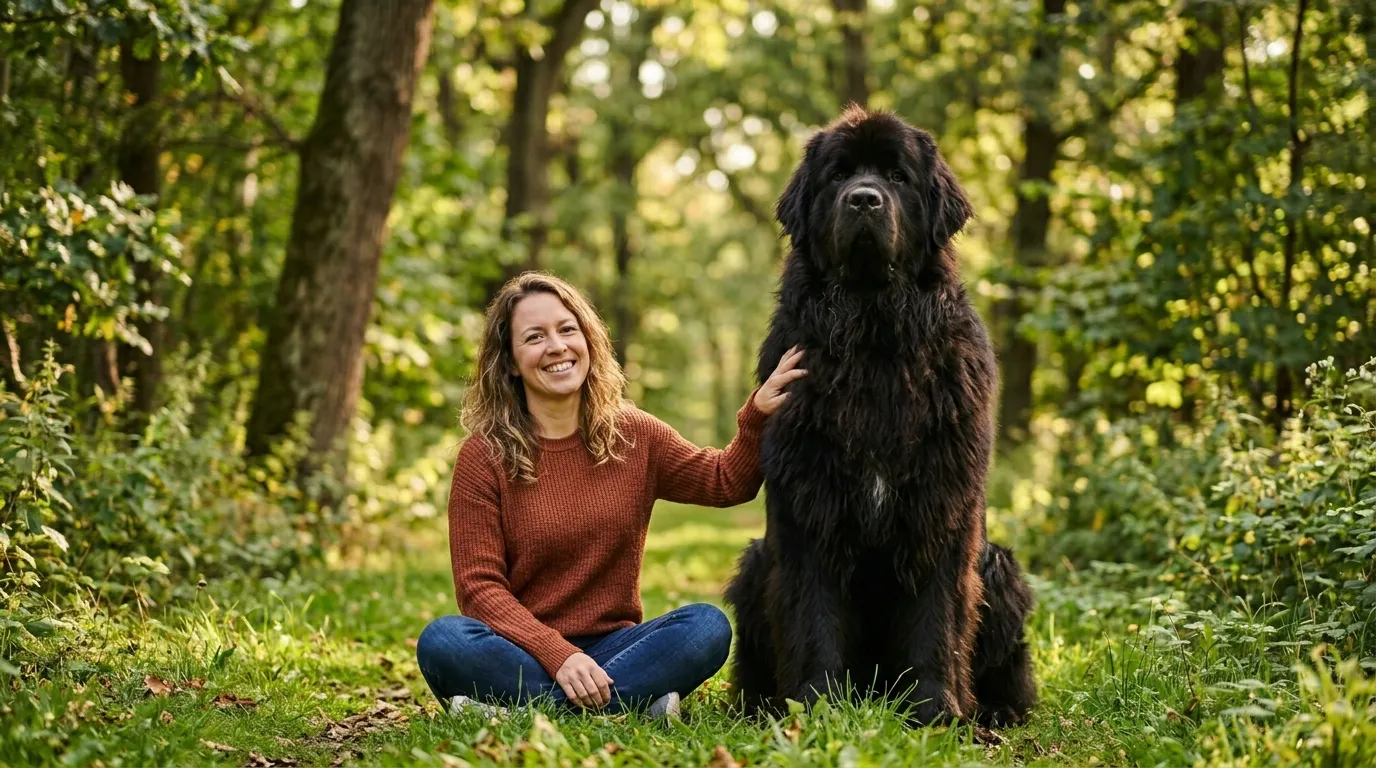
If you have ever seen a Newfoundland dog in person, you already know there is no other breed quite like it. Massive in size, gentle in spirit, and deeply devoted to the people they love — the Newfoundland is often called the gentle giant of the dog world, and for very good reason.
Whether you are researching the Newfoundland dog for the first time, trying to understand their size compared to a human, looking into Newfoundland dog price ranges, or considering bringing home a Newfoundland dog puppy — this complete guide covers everything you need to know in one place.
Let us dive in.
What Is a Newfoundland Dog?
The Newfoundland dog, affectionately known as the Newfie, is a giant working breed originally developed on the island of Newfoundland, Canada. Bred by fishermen to haul nets, pull carts, and rescue drowning sailors from icy waters, the Newfoundland is one of the most powerful and capable working dogs ever developed.
Today, the Newfoundland is primarily a beloved family companion — though their working instincts, love of water, and natural rescue abilities remain very much intact. They are known for their enormous size, thick double coat, webbed feet, and above all, their extraordinarily calm and gentle temperament.
The American Kennel Club (AKC) officially recognizes the Newfoundland in the Working Group, and they consistently rank among the most beloved giant breeds in the world.
Newfoundland Dog Size — How Big Do They Actually Get?
The Newfoundland dog size is one of the first things that surprises new owners — and sometimes even experienced dog people. These are genuinely massive animals.
Official AKC Size Standards
- Male Newfoundland: 28 inches tall at the shoulder, 130 to 150 pounds
- Female Newfoundland: 26 inches tall at the shoulder, 100 to 120 pounds
However, many Newfoundlands exceed these standards. Some males have been recorded weighing over 200 pounds, and the largest Newfoundland on record weighed an astonishing 260 pounds and measured over 6 feet from nose to tail.
Newfoundland Dog Growth Timeline
- 2 months old: 17 to 38 pounds
- 3 months old: 32 to 38 pounds
- 6 months old: Males 73 to 87 pounds, Females 59 to 72 pounds
- 12 months old: Approaching near-adult height
- 18 to 24 months: Reaches full adult size and weight
Newfoundland puppies grow at a remarkable pace — they can gain up to 100 pounds in their very first year of life. Despite reaching their full height around 12 months, Newfoundlands continue to fill out with muscle and body mass until they are about 18 to 24 months old.
Newfoundland Dog Next to Human — Size Comparison
One of the most searched questions about this breed is what a Newfoundland dog next to a human actually looks like — and the answer genuinely surprises most people.
A fully grown male Newfoundland standing on all fours reaches approximately 28 inches at the shoulder — roughly the height of an average person’s hip or waist. When a Newfoundland stands on their hind legs, which they are fully capable of doing, they can easily reach 5 to 6 feet tall, eye level with or even taller than most adult humans.
Sitting beside a seated adult, a Newfoundland’s head often reaches shoulder height. These dogs are not just large — they are genuinely comparable in physical presence to a small adult human. This is part of what makes them so beloved as family dogs — they feel less like a pet and more like a companion of equal stature.
For families with young children, the size comparison is even more dramatic. A Newfoundland puppy at just 6 months old can already outweigh a young child. Despite this, the Newfoundland’s gentle and patient nature makes them one of the most reliable and safe giant breeds around children.
Newfoundland Dog Weight — Full Breakdown by Age and Gender
Understanding Newfoundland dog weight at each stage of life is important for monitoring healthy development and adjusting feeding accordingly.
Male Newfoundland Weight Chart
- 3 months — approximately 38 pounds
- 6 months — approximately 73 to 87 pounds
- 12 months — approximately 100 to 115 pounds
- 18 months — approximately 120 to 140 pounds
- Full adult — 130 to 150 pounds (some exceed 200 pounds)
Female Newfoundland Weight Chart
- 3 months — approximately 32 pounds
- 6 months — approximately 59 to 72 pounds
- 12 months — approximately 85 to 100 pounds
- 18 months — approximately 95 to 115 pounds
- Full adult — 100 to 120 pounds
A healthy adult Newfoundland should have a visible waist when viewed from above and ribs that can be felt but not visibly seen. Extra weight places enormous strain on this breed’s joints and heart, and significantly shortens their already limited lifespan. Keeping your Newfoundland lean is one of the most important things you can do for their long-term health.
Newfoundland Dog Lifespan — How Long Do They Live?
The Newfoundland dog lifespan is one of the more sobering realities of owning this breed. Like most giant dog breeds, Newfoundlands have a shorter lifespan than smaller dogs.
- Average lifespan: 8 to 10 years
- Some well-cared-for Newfoundlands: 11 to 12 years
A 2024 UK study found the average life expectancy for Newfoundlands to be approximately 11 years — slightly better than older estimates — though this remains significantly shorter than the average for smaller breeds.
The Newfoundland’s large body size is the primary factor limiting their lifespan. Giant breeds age faster at the cellular level, and their hearts and joints bear enormous stress throughout their lives. The best things you can do to maximize your Newfoundland’s lifespan include:
- Maintaining a healthy, lean body weight throughout their life
- Regular veterinary check-ups including heart screening
- Appropriate low-impact exercise — swimming is ideal
- High quality nutrition appropriate for giant breeds
- Early detection and management of breed-specific health conditions
Newfoundland Dog Colors — Black and Beyond
When most people picture a Newfoundland, they picture a large Newfoundland dog black — and for good reason. Black is by far the most common and iconic color of the breed. However, Newfoundlands actually come in several recognized colors.
AKC Recognized Newfoundland Colors
- Black — The most common and classic Newfoundland color. A solid, deep black coat with a characteristic glossy sheen.
- Brown — A rich chocolate or liver brown, less common than black but equally striking.
- Gray — A beautiful steel gray coat, relatively rare among the breed.
- Landseer — White with black markings. Named after the artist Sir Edwin Landseer who frequently painted this color pattern. The Landseer is sometimes considered a separate breed in parts of Europe.
The black Newfoundland dog is the most recognized and widely seen. Their thick, black double coat is water-resistant and gives them a majestic, bear-like appearance that makes them instantly recognizable. All color variations share the same gentle temperament, size, and breed characteristics — color is purely cosmetic and has no effect on personality or health.
Newfoundland Dog Price — How Much Does a Newfie Cost?
The Newfoundland dog price is an important consideration for anyone thinking about adding one of these gentle giants to their family. Newfoundlands are not an inexpensive breed — either to purchase or to maintain.
Purchase Price
- Reputable breeder: $1,500 to $2,000 for a Newfoundland puppy
- Show quality or champion bloodlines: $2,500 to $4,000 or more
- Rescue or adoption: $100 to $500 through breed-specific rescues or shelters
Always purchase from a reputable, health-testing breeder. Responsible Newfoundland breeders perform DNA testing for cystinuria, hip and elbow dysplasia screenings, and cardiac evaluations on all breeding dogs. Avoid puppy mills, backyard breeders, and suspiciously cheap Newfoundland puppies — the savings upfront often mean enormous veterinary costs later.
Ongoing Monthly Costs
- Food: $100 to $150 per month — Newfoundlands eat a lot
- Grooming: $80 to $150 per professional grooming session every 6 to 8 weeks
- Veterinary care: $500 to $1,000 annually for routine care, more for senior dogs
- Pet insurance: $80 to $150 per month — highly recommended for this breed
- Supplies (bed, toys, leash, bowls): Larger sizes cost significantly more than standard sizes
The true cost of owning a Newfoundland over their lifetime can easily reach $20,000 to $30,000 or more. This is not a breed to buy on impulse — financial preparedness is an important part of responsible Newfoundland ownership.
Newfoundland Dog Puppy — What to Expect in the First Year
Bringing home a Newfoundland dog puppy is a joyful and often hilarious experience — but it also requires serious preparation. Newfoundland puppies grow at a speed that genuinely has to be seen to be believed.
The First Week Home
Give your Newfoundland puppy time to adjust to their new environment. Set up a large, comfortable sleeping area and keep the home calm and welcoming. Expect some whining, nervous behavior, and frequent accidents as they settle in.
Feeding a Newfoundland Puppy
Newfoundland puppies need food formulated specifically for giant breeds. Standard large breed puppy food is not appropriate — giant breed formulas have controlled calcium and phosphorus levels that support slow, steady bone growth and significantly reduce the risk of skeletal problems.
- 8 to 12 weeks old — 3 to 4 meals per day
- 3 to 6 months — 3 meals per day
- 6 months and older — 2 meals per day
Never free-feed a Newfoundland puppy. Controlled portions at scheduled meal times prevent obesity and support healthy growth.
Exercise and Joint Protection
This is one of the most important things to understand about Newfoundland puppies. Because they grow so rapidly, their bones and joints are fragile during the first 18 to 24 months. Avoid high-impact exercise such as:
- Jogging or running on hard surfaces
- Repetitive jumping or stairs
- Forced long-distance walks
Instead, allow free play on soft grass, short gentle walks, and swimming — which is the ideal low-impact exercise for this breed at any age. Pushing a Newfoundland puppy too hard physically before their growth plates close can cause permanent joint damage.
Early Socialization and Training
Start socialization and basic training the moment your Newfoundland puppy comes home. Expose them to different people, sounds, environments, and animals early and often. A Newfoundland that is 150 pounds and not well-socialized is a serious challenge to manage. The same dog that is gentle, obedient, and well-socialized is an absolute joy.
Basic commands — sit, stay, come, down, and loose-leash walking — are essential for a dog of this size. Enroll in a puppy class and work with a trainer experienced with giant breeds if needed.
Newfoundland Dog Temperament — The Gentle Giant
The Newfoundland’s temperament is one of the most celebrated of any dog breed in the world. These dogs are often described using words that seem almost impossibly positive — and yet every description proves accurate in person.
- Gentle — Extraordinarily so. Newfoundlands are famously patient and soft with children, elderly people, and other animals.
- Calm — Despite their size, adult Newfoundlands are remarkably laid-back indoors. They are not hyperactive or destructive.
- Loyal — Deeply devoted to their family. Newfoundlands form powerful bonds and can be prone to separation anxiety if left alone too frequently.
- Intelligent — Quick learners that respond very well to positive reinforcement training.
- Protective — Natural protectors without aggression. A Newfoundland will place themselves between their family and a perceived threat, but very rarely shows aggression.
- Social — Friendly with strangers, excellent with children, and generally good with other dogs and pets.
The Newfoundland is not a guard dog in the traditional sense — they are far too friendly for that. They are, however, a natural protector and an incredibly reassuring presence in any home.
Newfoundland Dog Health — Common Conditions to Know
Like all purebred giant dogs, the Newfoundland is predisposed to certain health conditions. Being aware of these before buying or adopting helps you make informed decisions and catch problems early.
- Hip Dysplasia — Abnormal development of the hip joint. Very common in giant breeds. Managed with weight control, joint supplements, and in severe cases, surgery.
- Elbow Dysplasia — Similar to hip dysplasia but affecting the elbow. Can cause lameness and pain. Reputable breeders screen for this.
- Subvalvular Aortic Stenosis (SAS) — A serious heart condition unique to Newfoundlands. Can cause sudden death in severe cases. Requires cardiac screening and ongoing monitoring.
- Gastric Dilatation-Volvulus (Bloat) — A life-threatening emergency where the stomach fills with gas and twists. Requires immediate emergency surgery. Feed smaller meals, avoid exercise immediately after eating, and know the signs.
- Cystinuria — A genetic kidney condition that causes bladder stones. DNA testing is available and responsible breeders screen for it.
- Hypothyroidism — Low thyroid function causing weight gain, lethargy, and coat problems. Manageable with daily medication.
- Wobbler Syndrome — A neurological condition affecting the spine, causing a wobbly gait. More common in giant breeds. Surgery is often required.
Always buy from a breeder who performs all recommended health screenings and provides documentation. Pet insurance is strongly recommended for Newfoundlands — their size means that even routine veterinary care is more expensive than average, and any of the above conditions can result in very significant costs.
Newfoundland Dog Grooming — Managing That Magnificent Coat
The Newfoundland’s thick double coat is beautiful, water-resistant, and completely magnificent — it is also a serious grooming commitment. This is not a breed for anyone who does not want dog hair in their home.
- Brushing: At least three to four times per week, every day during shedding season. Use a long-tooth slicker brush and a metal comb to work through the dense undercoat.
- Bathing: Every six to eight weeks, or more often if your Newfoundland swims or gets muddy. Their thick coat takes a very long time to dry — a high-velocity dryer is extremely helpful.
- Shedding: Newfoundlands shed heavily twice a year — spring and fall. During these periods, daily brushing is essential. Expect significant amounts of hair throughout your home year-round.
- Nail trimming: Every three to four weeks. Long nails on a dog this heavy cause joint stress and pain.
- Ear cleaning: Weekly check and clean. Newfoundlands that swim frequently are especially prone to ear infections.
- Dental care: Brush two to three times per week minimum using dog-safe toothpaste.
Professional grooming every six to eight weeks is highly recommended. A full groom for a Newfoundland is a significant job and not something all groomers are equipped to handle — find a groomer experienced with giant breeds.
Newfoundland Dog for Sale — How to Find One Responsibly
If you are searching for a Newfoundland dog for sale, the most important thing is to find a responsible, ethical source.
Reputable Breeders
Look for breeders who are members of the Newfoundland Club of America or their country’s equivalent breed club. Responsible breeders will:
- Perform all recommended health screenings on both parents
- Raise puppies in a home environment with full socialization
- Welcome you to visit and meet the parents
- Ask you detailed questions about your lifestyle and home
- Provide a health guarantee and take dogs back if you can no longer keep them
- Have a waitlist — good breeders are always in demand
Rescue and Adoption
There are Newfoundland-specific rescue organizations in most countries. Adopting an adult Newfoundland through rescue is a wonderful option — you skip the demanding puppy phase, the dog’s temperament is already fully formed, and you give a deserving dog a second chance at a loving home.
What to Avoid
- Pet stores — almost always source from puppy mills
- Online ads with no breeder information or the ability to visit
- Breeders who always have puppies available with no wait
- Prices that seem too good to be true
- Sellers who cannot provide health testing documentation
Is a Newfoundland Dog Right for You?
The Newfoundland is one of the most rewarding dog breeds in the world — but they are absolutely not the right dog for everyone. Before committing, be honest with yourself about the following:
- Space: Newfoundlands need room. A small apartment is not ideal, though they can adapt with enough daily exercise. A home with a yard is strongly preferred.
- Budget: Food, grooming, veterinary care, and supplies for a giant breed cost significantly more than for an average-sized dog.
- Time: Grooming, exercise, training, and companionship all require a real time commitment.
- Mess tolerance: Newfoundlands drool, shed heavily, and track mud and water. Your home will not look the same after a Newfie moves in.
- Heart: With an average lifespan of 8 to 10 years, owning a Newfoundland means preparing for heartbreak sooner than most breeds. Many owners describe losing a Newfie as one of the most difficult experiences of their lives — and then immediately get another one.
If you have the space, the budget, the time, and the tolerance for a house full of fur and drool — the Newfoundland will reward you with a level of love, loyalty, and gentle companionship that is simply unmatched in the dog world.
Quick Reference: Newfoundland Dog Breed Facts
- Breed Group: Working
- Size: Giant
- Height: Males 28 inches, Females 26 inches
- Weight: Males 130 to 150 lbs, Females 100 to 120 lbs
- Lifespan: 8 to 10 years
- Colors: Black, Brown, Gray, Landseer (white and black)
- Temperament: Gentle, calm, loyal, intelligent, protective
- Good with children: Excellent
- Good with other pets: Yes
- Grooming needs: High
- Exercise needs: Moderate
- Price range: $1,500 to $2,000 from reputable breeders
- Origin: Newfoundland, Canada
Frequently Asked Questions About the Newfoundland Dog
How big does a Newfoundland dog get?
A fully grown male Newfoundland typically stands 28 inches tall at the shoulder and weighs between 130 and 150 pounds. Females are slightly smaller at 26 inches and 100 to 120 pounds. Some males exceed 200 pounds.
What is the Newfoundland dog price?
A Newfoundland puppy from a reputable health-testing breeder typically costs between $1,500 and $2,000. Show quality puppies from champion bloodlines can cost $2,500 to $4,000 or more. Adoption through rescue is available for $100 to $500.
How long do Newfoundland dogs live?
The average Newfoundland dog lifespan is 8 to 10 years. Some well-cared-for Newfoundlands live to 11 or 12 years. Maintaining a healthy weight and regular veterinary care are the most important factors in maximizing lifespan.
Are black Newfoundland dogs the most common?
Yes. The black Newfoundland is the most common and iconic color of the breed. Other recognized colors include brown, gray, and Landseer (white with black markings).
Are Newfoundland dogs good family pets?
Absolutely. When well-socialized and trained, Newfoundlands are exceptional family pets. They are famously gentle and patient with children, loyal to their family, and calm indoors. Their size requires supervision around very young children, but the Newfoundland’s temperament is among the best of any breed.
Do Newfoundland dogs drool a lot?
Yes. Newfoundlands are known droolers, especially after drinking water or eating. This is a normal and expected characteristic of the breed. If drooling is a dealbreaker for you, a Newfoundland is probably not the right dog.
How tall is a Newfoundland dog next to a human?
Standing on all fours, a Newfoundland’s shoulder reaches approximately hip or waist height on an average adult human. When standing on their hind legs, a large Newfoundland can reach 5 to 6 feet — eye level with most adults.
Final Thoughts
The Newfoundland dog is not just a pet — they are a presence, a companion, and for many owners, a once-in-a-lifetime experience. From their extraordinary size and iconic black coat to their impossibly gentle temperament and natural love of water, everything about this breed is remarkable.
Yes, they are expensive. Yes, they require significant grooming, space, and financial commitment. Yes, their lifespan is heartbreakingly short. And yes — almost every Newfoundland owner will tell you without hesitation that every single moment was absolutely worth it.
If you are ready to welcome a gentle giant into your home, the Newfoundland dog might just be the most rewarding decision you ever make.
Have questions about the Newfoundland dog breed? Drop them in the comments below — we would love to help you find your perfect gentle giant!